


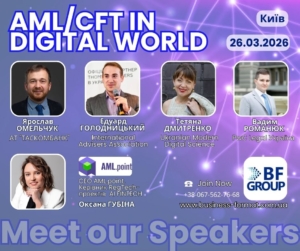


On March 26, 2026, Kyiv hosted the international conference “AML/CFT in Digital World – 2026,” bringing together leading experts, financial institutions, technology companies, and analytics providers to discuss the evolving challenges of financial security in the digital era .
During the event, Dr. Tetiana Dmytrenko, Professor of Economics and Chairwoman of UMDS (Ukrainian Modern Digital Science), delivered a presentation on international sanctions and their practical application, and moderated a professional panel on challenges of verification and identification. The discussion featured experts from AMLbot, Crystal Intelligence, Global Ledger, as well as leading practitioners in compliance and financial security.
A central theme of the discussion was the growing gap between formal compliance frameworks and real financial behavior. Despite significant investments in AML, KYC, and sanctions compliance, the system remains vulnerable to complex schemes involving money laundering, sanctions evasion, and fraud. Experts emphasized that the traditional paradigm of “who is your customer” is increasingly being replaced by “how the customer behaves within financial networks.”
Special focus was placed on practical cases of sanctions evasion, crypto-financial flows, and network-based risks. It was highlighted that modern criminal ecosystems operate as technology-driven platforms, leveraging cryptoassets, jurisdictional gaps, artificial intelligence, and rapid adaptability.
Participants concluded that effective financial crime prevention requires a fundamental shift:
from formal compliance to risk intelligence,
from transaction-level monitoring to network analysis,
from static controls to behavioral analytics and predictive models.
AML, KYC, and sanctions frameworks are evolving into tools not only of compliance but of financial security. Yet, one key question remains: are we truly staying ahead of financial crime — or merely catching up?
