5th Winter Symposium on Economic Crime 2024 “Economic Crime in a Time of War” d Portsmouth University
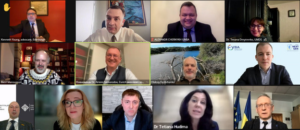
At the 5th Winter Symposium on Economic Crime: Economic Crime in Wartime, dedicated to the impact of economic crime on the course of the war in Ukraine, which took place on January 12, 2024 and was organized by the Center for Cybercrime and Economic Crime at the University of Portsmouth, I presented our joint work, UMDS experts on moving capital out of Russia and then evading sanctions with crypto-assets, our involvement in the development of EU sanctions packages.
Economic crimes during the Russian-Ukrainian war illustrate the profound impact of fraud, corruption, and sanctions evasion on national security and global peace. The evidence that economic crime is a significant problem in military operations has initiated a significant policy shift in the fight against economic crime from a purely financial activity to a policing activity motivated by the protection of national security. Alongside changes in laws and regulations against economic crime, criminal justice actors in the UK and internationally should review their priorities, which authorities should have jurisdiction, and work together to gain a more holistic understanding of the actors and networks involved.
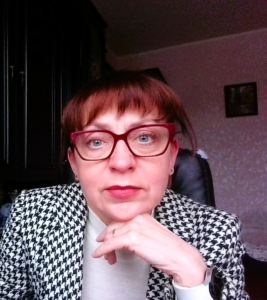
The 5th Winter Economic Crime Symposium brings together a diverse group of researchers, practitioners, students, and other community members to discuss combating economic crime in wartime. On behalf of our UMDS organization, the Chairman of the Board, Dr. Tatiana Dmytrenko.
Dr. Vasilius Karagannopoulos, professor of Portmouth University gave two interviews to the press on the topic of the event. More details: https://www.dw.com/…/ukraine-war-whats-the…/a-67775539
Stockholm Fintech Week 2024
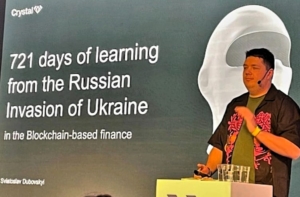
Two years of war is not really an anniversary, especially when the war in Ukraine has been almost ten years old. It is very important to share accumulated experience, information from primary sources in different countries of the world, which is what our expert and Vice President of Sales of Crystal Company and UMDS expert Sviatoslav Dubovsky did at the Stockholm Fintech Week, which took place on February 12-18, 2024.
Svyatoslav discussed the need for stronger controls in the crypto industry to prevent entities from using sanctions to hide funds and circumvent laws.
Regulatory measures and scrutiny: Since Russian banks have been cut off from SWIFT, they have turned to cryptocurrency trading, seeing decentralized virtual assets as an alternative revenue stream that avoids sanctions.
Impact on the Global Cryptocurrency Market: The invasion and subsequent sanctions caused significant volatility in the global cryptocurrency markets. Initially, there was a drop in the value of major cryptocurrencies, possibly due to a general shift away from riskier assets. However, the market also saw an increase in trading volumes, partly due to Russian and Ukrainian users.
Humanitarian aid and fundraising: On the other hand, cryptocurrencies have also been used for positive purposes such as humanitarian aid. Various blockchain-based fundraising initiatives have been launched to support Ukrainian refugees and the country’s defense efforts. These platforms have provided a quick and transparent way to direct funds to those who need them.
Blockchain for transparency and accountability: Some initiatives have used blockchain technology to ensure transparency and accountability in the distribution of funds and aid.

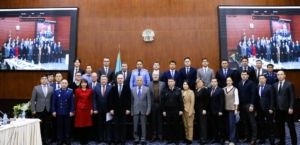
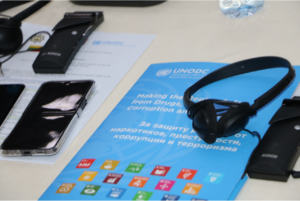
Kazakhstan, Koshi 2024
Conference “Virtual Assets: Recovery of Criminal Assets, Fraud Risks, Financial Pyramids, Online Drug Trafficking”
From February 19 to 20, 2024, at the invitation of the Law Enforcement Academy, we took part in an international conference organized jointly with UNODC with the support of the Embassies of the United States and the Republic of Lithuania in the Republic of Kazakhstan. The event called “Virtual assets: recovery of criminal assets, risks of fraud, financial pyramids, online drug trade” attracted international experts from the UK, Ukraine, Georgia, Romania and Lithuania to discuss current issues in the field of virtual assets and their impact. The law enforcement officers were especially pleased to hear the positive results of the investigation into the activities of “financial pyramids” (Ponzi schemes), in which our experts from Global Ledger and Сrystal also participated. Later, we will definitely share the results of this cooperation. I am currently announcing a series of basic and advanced level trainings for representatives of the law enforcement system and regulators of the Republic of Kazakhstan, as well as representatives of the banking sector and crypto exchanges, in accordance with the training agreement between AFSA and the Ministry of Digital Affairs of Kazakhstan. More details: https://academy-gp.kz/?p=19684&lang=ru
Cyber Scotland Week 2024
The active use of digital technologies and cryptocurrencies in all spheres of life raises questions about human rights and freedoms in the digital world. Modern challenges require their careful study, in particular adaptation to the global environment, preservation of basic values and harmony between individual rights and collective needs of society.
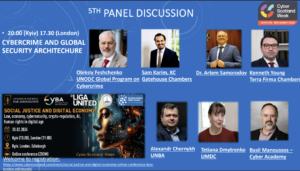
This was the conclusion reached by the participants of the conference “Social Justice and the Digital Economy: Cybersecurity, Cryptoregulation, AI, Human Rights in the Age of Digital Technologies”, which was held as part of Cyber Scotland Week 2024.
The event was initiated by the representative of UNAB in Scotland, the United Kingdom of Great Britain and Northern Ireland, Oleksandr Chernykh, in cooperation with British scientific institutions, the state institution “VK Mamutov Institute of Economic and Legal Research of the National Academy of Sciences of Ukraine”, the organization “Ukrainian Modern Digital Science” (UMDS), the Ukrainian IT company “LIGA ZAKON” and the European Association of Young Lawyers. More details: https://tinyurl.com/yo3k59eu