


The image was generated by the Google’s Nano Banana
Middle Ages Finances Combined with Crypto – a Perfect Tool to Bypass Sanctions
The West is playing a whack-a-mole game with the financing of Russian foreign trade for years: some banks, more banks, credit cards, crypto, more crypto, even more crypto. But now, the A7 holding has created an (almost) perfect tool. It allows circumvention of sanctions, avoidance of licensing and regulation, and can attract even more liquidity.
What did they need? To combine the financial technology originating in the Middle Ages with cryptocurrencies and use two friendly jurisdictions – one in the EU, one very close to Russia.
How? Ukrainian Modern Digital Science (UMDS) and the AMLBot put all the puzzle parts together and explain how it works. The crucial information have been published by the Reporter.london and context.ro (https://reporter.london/?p=1579 )
A7A5 – a Brief Story
A7A5 is a cryptocurrency token – “stablecoin”, backed by the Russian Rouble (RUB), and its exchange rate A7A5/RUB is 1:1. A7A5 has been created by the A7 – Russian financial company, and its beneficiary owner is Ilan Shor, as reported by CIR: https://www.info-res.org/app/uploads/2025/06/A7A5-Report-June-2025-Final-Draft-1.pdf. Initially, the A7A5 was launched in Kyrgyzstan.
A7A5 has been created to facilitate foreign trade with Russia and bypasses the traditional financial system, avoiding sanctions. After the publication in June 2025 by the Financial Times, reports by CIR and blockchain investigation companies Global Ledger and Elliptic, A7A5 was sanctioned by the USA and the UK in August 2025. The EU sanctions followed in October 2025. After the sanctions, A7 has opened its financial center in Vladivostok, Russia.
But did it survive the sanctions? The answer is in the blockchain.
A7A5 – Numbers in Blockchain
The AMLBot researchers have analyzed the A7A5 activity on the Tron blockchain (where most of the A7A5 liquidity is). One chart is enough: the daily volume of exchange A7A5-USDT:
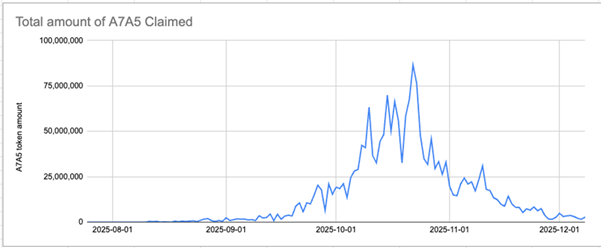
Figure 1. Daily volume of A7A5 token claimed. Provided by the AMLBot
After a brief drop in September after the sanctions, the volume went up again. According to the AMLBot, there are two types of A7A5 users:
- “retail” small volume transactions via the A7A5 website are now approximately one A7A5 (RUB) million daily, likely small investors or persons paid in A7A5 for services
- “wholesale” large transactions via A7A5 smart contracts are now at approximately RUB50-80 million daily, likely driven by foreign trade and large investors.
So, it is alive. Who has saved it? The answer is in the blockchain again
A7A5 – Money in Blockchain
It is possible to trace cryptocurrencies. Also, it is possible to analyze the behaviour of the smart contracts. The AMLBot researchers have done it. And the finding was extraordinary:
Almost 2 billion USDT of liquidity has been added to A7A5 in 2025. Out of them 375 mln came from the HTX exchange.
What Now?
We need four pieces of information.
One: there is enough liquidity, and you can change A7A5 to and from USDT. We already know it.
Two: if you change USDT to A7A5 and hold A7A5 token, you earn half of the interest rate in Ruble (as of now, the interest rate of the Russian Central Bank is 16%, you can expect around an annual 7-8%). A7A5 says so: docs.a7a5.io/introduction-to-a7a5/how-to-earn-using-a7a5
Three: A7-Kyrgyzstan is issuing the promissory notes. A7A5 is advertising it: www.a7a5.kg/cryptonote/about
Four: A7 has created a company in Hungary (founded by the Kyrgyzstan state-owned company). Reporter.london and context.ro have dug it (see the same link https://reporter.london/?p=1579 )
Ok, it was all about crypto. What are the promissory notes?
Promissory notes are known under different names – Bill of Exchange, IOU, Wechsel, вексель, depending on your language and jurisdiction. This is a very old financial instrument, created by Italian bankers almost a thousand years ago. The idea is simple: instead of moving physical money, you can take a paper note. On this note, someone, e.g., an issuer from Milano, promises that his colleague in Bologna will repay the person who presents this note. It became widely popular, evolved, and got an elaborate set of rules and procedures. It has been formalized in the Geneva Convention of 1930, which provided a Uniform Law for Bills of Exchange and Promissory Notes.
The Convention is old, older than the EU, but it is still in force in most European and ex-Soviet countries. As for the common law countries, Australia, Canada, and New Zealand have their legislation based on the UK Bills of Exchange Act.
The promissory notes can be used as security for consumer debts (if you have a mortgage with a German bank, you probably signed a Wechsel), but they can also be used only between two businesses or individuals.
There is one very important point: the EU Directives regulate only the use of promissory notes in business relationships with customers. Private deals involving promissory notes are just between the parties, as with any regular commercial deal.
So, getting back to A7. They have awoken something ancient in the darkness, but why?
Two Upward Spirals
A7A5 can create two “upward spirals” that will bring it even more liquidity and allow it to serve even more of Russia’s foreign trade. Of course, bypassing the European regulations, licenses, and sanctions.
Going Up 1: Carry Trade
“Carry trade” is a well-known way to make money (very big money): borrow at a low rate, earn more in another market, exchange back, and repay. If you are not familiar with the volumes, just look in the Internet for “August 2024 carry trade unwind”.
For the A7A5 carry trade works like:
- Ample liquidity attracts investors for “carry trade”: borrow some hard currency (e.g., in USA, Japan, or China money markets you can borrow below 4% annual rate, convert to USDT, invest into A7A5, profit at 7-8%, exchange back to USDT, then to the initial currency, repay the loan. Keep profits, repeat.
- The carry trade brings more USDT liquidity to A7A5, allowing more exchange deals to facilitate foreign trade with Russia.
- More liquidity from foreign trade attracts even more carry trade liquidity, and so on…
Going Up 2: Cash-Out of Crypto in Europe
Exchanging cryptocurrency for Euro (or other “fiat” money) is a regulated activity in Europe – such an exchange business has to be licensed (and the license is neither cheap nor easy to obtain), regulated and supervised, and must apply anti-money laundering measures.
But remember the promissory notes? They can be issued, transferred, bought, and sold, and redeemed in the business-to-business interactions in Europe without all that special regulation.
One more critical detail: the so-called “avail” of the promissory notes. An example: Alice issues a promissory note to Bob, promising to repay him EUR 100,000 in one month. But they know that at that time Bob will be in another place and cannot request payment. So, they ask the third person, Charlie, to “avail” the note, i.e., sign that he will also repay the note, if it is presented to him. So, in one month, Bob presents the promissory note to Charlie, he is obliged to repay it, and later he settles the balance with Alice.
Now, the second upward spiral can look like:
- Someone in Europe needs to cash out A7A5, but the token is sanctioned, and therefore, it’s not possible to use a regulated crypto exchange. Or, someone needs to cash out USDT (or other crypto), but doesn’t want to do it via the regulated service
- Now, they either already own A7A5 or buy it with USDT via the A7A5 smart contract. This step is not regulated by the EU (the service provider is in Kyrgyzstan, the deal is conducted in blockchain via the A7A5 smart contract)
- Next, the A7A5 can exchange the A7A5 token for the promissory notes. Issued by the A7-Kyrgyzstan. If you want an additional guarantee, the note can be availed company can provide it. Again, this service is provided outside the EU (Kyrgyzstan, again)
- The client now presents the promissory note to the Hungarian company. They either buy it (a regular deal), or, in case it is availed by them, repay it (also a regular deal). Now, one EU company pays another in Euros under a regular business deal. No regulations, no licenses, and no extra controls
- More clients go via A7A5 just to cash out their crypto in Europe, more liquidity for A7A5, more liquidity, and so on, like in the carry trade spiral
The Moral
Sanctions and their evasion are an endless “arms race”. Now, the A7A5 has survived the previous round of sanctions and has come up with the improved tools. Delays with sanctions allowed A7A5 to become more resilient and to attract more liquidity. The longer they operate – the more opportunities to bypass sanctions. UMDS and the AMLBot continue to monitor.
But there is one peculiar detail in this saga. Have you noticed a special role of Kyrgyzstan? Yes, the part of the activities that must be regulated under the FATF requirements all take place in Kyrgyzstan. And Kyrgyzstan state-owned company is a founder of the Hungarian company in the scheme.
The EU has the list of high-risk jurisdictions for money-laundering and terrorism-financing controls, and in December 2025, Russia was added to the list. Maybe it is worth to reassess the risks of Kyrgyzstan?
